
Self-Mentoring: Reparenting Your Inner Teen

In my last blog, I introduced reparenting as a form of self-care for inner child healing.
Now let’s talk about another voice you might be hearing alongside your inner child — one that’s angrier, more cynical, even rebellious.
As many of my clients can currently attest, August jumpstarts back-to-school season, and with it, familiar seasonal anxieties regarding performance, social pressure, and identity — all of which amplify that voice.
If this resonates, you may be hearing your inner teen, an overlooked and misunderstood part of you who often starts speaking up once your inner child quiets down.
What is an inner teen?
Imagine this:
Your psyche is a car.
Your inner child needs your adult Self to be in the driver's seat, in control the whole time.
Your inner teen, on the other hand, is a student in the driver's seat who will pick and choose what input to take from your adult Self, relegated to the role of a supervisor riding shotgun.
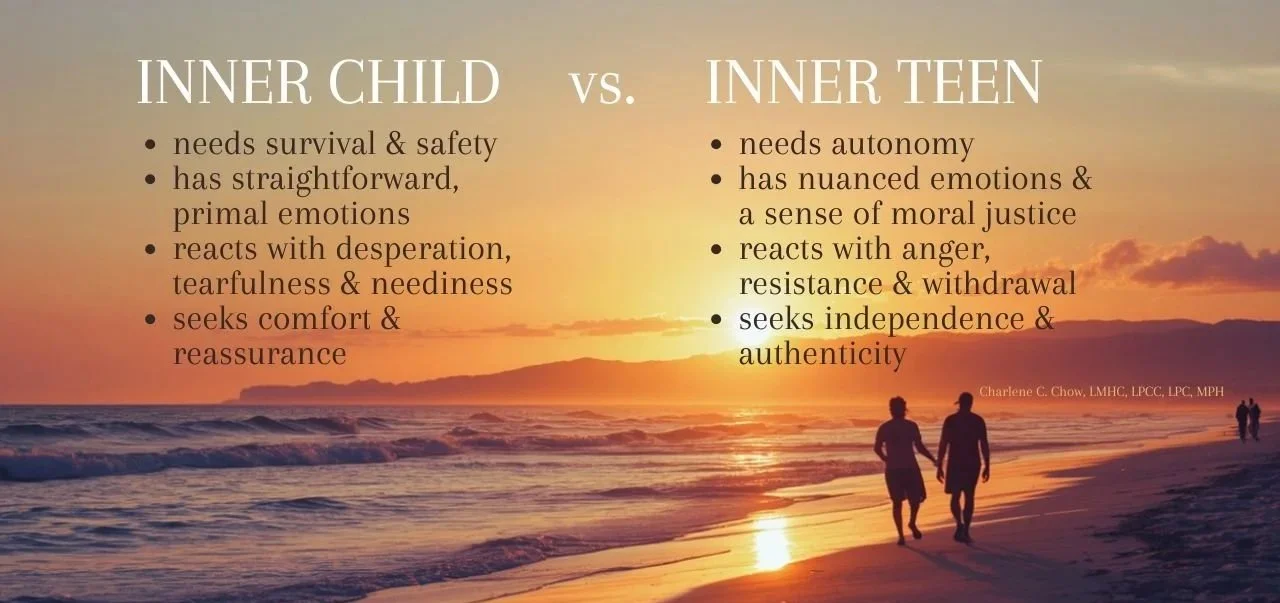
We all have an inner teen: the subconscious part of the mind that holds your adolescent memories, feelings, beliefs, passions, and coping mechanisms.
Just as with your inner child, these can persist long into adulthood. Likewise, certain groups are more likely to carry this emotional injury: intersectional and "othered" identities, inclusive of individuals who are socioeconomically disadvantaged, disabled, neurodiverse, belonging to LGBTQ+ communities, and of course black, indigenous, and other people of color (BIPOC).
However, your inner teen is different in several ways:
Vastly more lived experience — both positive and negative.
Willful and concrete opinions, judgments, and feelings about yourself, others, and the world.
Courage to protest authority and resist injustice.
Quick to react with frustration and anger.
What are inner teen wounds?
These are emotional injuries sustained in adolescent years.
While your inner child holds your basic needs and innocence, your inner teen carries your drive for identity on top of the unhealed scars of early rejection, abuse, or loss of control.
Like inner child wounds, these can reopen when triggered in adulthood.
As an adult, inner teen wounds may mimic inner child wounds:
Fear of rejection.
Perfectionistic tendencies.
Chronic people-pleasing and self-abandonment.
Lack of assertiveness, even with ‘small’ things.
Weak boundaries with others and yourself.
Enmeshment or codependency in relationships.
Addictive or self-sabotaging behaviors.
Overly judgmental self-talk.
Chronic low self-esteem, unworthiness, guilt, and shame.
However, inner teen manifestations ALSO include:
Not just wanting to “fit in” but needing to belong.
Procrastination and conflict aversion.
Impulsive decision-making.
Anxiety, especially social, along with masking and burnout.
Difficulty adapting to authority and shifting power dynamics.
Heightened reactivity, defensiveness, or loss of emotional control when you don’t get your way.
Check in with yourself:
Do you see yourself anywhere in this list?
Are you carrying any inner teen wounds of your own?
What causes inner teen wounds?
Both inner child and inner teen wounds originate from the same 5 core sources.
If anything, these foundational injuries can intensify during adolescence:
1. Rejection
Caregivers make you feel unwanted through rejection or favoritism. This impairs self-esteem. You may withdraw preemptively from relationships in an attempt to avoid future rejection.
2. Abandonment
Caregivers consistently fail to meet your needs, leaving you alone and unsupported. You learn your emotional needs are unimportant, and seek reassurance from others that you have not failed them.
3. Humiliation
Caregivers show primarily negative attention: controlling, criticizing, judging, or belittling you. You may feel shame and become self-sacrificing, shrinking yourself to avoid further attention.
4. Betrayal
Caregivers habitually lie, manipulate, and disappoint you. You come to expect loved ones to fail you, seek control in relationships, and become hypervigilant for signs of betrayal or disloyalty.
5. Injustice
Caregivers set unreasonable standards and show love based on your performance. You learn love is conditional and must be “earned,” and develop a mask of stoicism to protect your feelings.
Knowing which of these wounds molded your internal landscape provides a place to start healing.
How does inner teen healing happen?
If you try to "reparent" your inner teen the same way you do your inner child, you may meet fierce internal resistance. Efforts to make changes will stall.
This is because while your inner child requires gentle parenting and comfort to form safe attachments, your inner teen has a different job: to figure out who you are as a soon-to-be-adult, alone in the world, and independent from your family.
Your inner teen has had years to establish its own “grown-up” values and observations.
It doesn’t want to be coddled, micromanaged, or commanded. It wants to be heard, respected, and given a chance to grow on its own terms.
It wants to live with authenticity and agency.
An example:
Let’s say you witness favoritism at work. This triggers an inner teen urge to withdraw and stew silently, rather than seeking productive solutions with a supervisor.
No amount of compassionate self-talk can resolve your inner teen's anger because the injustices of professional rejection and abandonment are real.
Your inner teen considers its reactions justified, and knows no other way to change or cope with the situation.
Reparenting for your inner teen looks less like self-soothing and more like self-mentorship...............................................................................................................................
Reparenting for your inner teen looks less like self-soothing and more like self-mentorship...............................................................................................................................
What does reparenting self-mentoring your inner teen look like?
The answer is NOT more hand-holding, but patient guidance from a trustworthy, reliable mentor.
While a parent takes ownership to protect you, a mentor only leads by example; they back you up if needed, but otherwise give you space to experiment with your own identity and growth.
To step into a mentorship role with your inner teen, start with these 4 things:
1. Validate your younger self.
Don’t shy away from awkward teen memories. A good mentor understands that these add to insecurities and subtract from self-esteem, creating the protective mask that your inner teen wears today.
These experiences are not to be mocked, minimized, or ignored, but acknowledged.
Be the witness your inner teen needs.
Try this:
Next time you feel insecure or self-conscious, tell your inner teen: "I know you felt that way then, so I get why it's coming up now. But this is a different experience, and we have power in this moment."
2. Identify your triggers.
Your inner teen reacts in patterns — what are they? And what emotions come up in these moments?
Ask these questions not as a micromanaging parental figure, but as an impassive third party simply offering a second pair of eyes to your inner teen.
This means: look within, and listen.
Things to look for:
- Situations where you react uncharacteristically.
- Disproportionately intense feelings.
- Cognitive distortions like all-or-nothing or catastrophizing beliefs.
3. Embrace teamwork.
A good mentor will have your inner teen's back, however they answer.
Face your inner teen not as a parent trying to force compliance, but as a teammate wanting to work collaboratively with them.
This means: negotiate.
Show yourself the respect you sought as a teenager. Find a compromise that honors both your adult duties and your inner teen’s desire for control.
Try this:
Treat your inner teen like a capable individual you'd like to know better.
Ask: "Why are you reacting this way? What do you need? What are you making up for now that you missed out on growing up?"
If it's hard to answer, try journaling or exchanging letters with your inner teen to start.
4. Promote your passions.
What “fun” interests feel nostalgic for you?
Maybe you channeled some of these things into a career — or abandoned them in the name of growing up.
As an adult, you have something your inner teen never did: the actual freedom to take charge of your life — to be whomever you want.
Diving into old passions is a direct line to your inner teen, and a clear path toward healing self-sacrificial wounds. Set boundaries that protect these now.
Exercise your power.
Try this:
- Put on your favorite teen-era playlist.
- Pick up an old game, book, instrument, or sport.
- Reconnect with someone you were close to in high school.
Live in a way that makes your inner teen say "We grew up to be even better than imagined."
If August feels like a mental and emotional drag, double-check whether it’s your inner teen projecting old survival tactics onto your current corporate, academic, or social life.
Healing requires witnessing and walking alongside a past version of yourself who had unrealized hopes and dreams — looking backward to move forward.
Emotional wounds don’t heal easily, but you are capable of subverting maladaptive patterns and developing new emotional strategies for old pains.
You have the power to cultivate an unapologetically authentic version of yourself today.
“It is never too late to be what you might have been.”
Ready to take the next step?
It can feel harder to connect with your inner teen compared to your inner child, but you don’t have to do it alone. In fact, a large part of healing relational wounds happens in connection.
Inner teen work is one of many processes I love collaborating on with clients in my practice, typically through a combination of CBT, distress tolerance, expressive arts, mindfulness, and trauma-informed approaches.
If that interests you, you’re welcome to schedule a complimentary 10-minute phone consultation with me here.
It would be my honor to hold safe space for you and your inner teen on your journey of self-mentorship, emotional self-sufficiency, self-actualization, and healing.
Disclaimer: This blog is intended for informational purposes only, and does not constitute medical or psychiatric advice. Please consult with a qualified healthcare professional directly for personalized guidance and support.