
Mind Over Meta: Find Digital Satiety In An “Always-On” World
We inhabit an “always-on” world.
The more extensive your digital life, the more it bleeds into other real-world identities you hold.
This fast-paced world, driven by social media and AI, is one our brains did not evolve to thrive in.
If you’re feeling frazzled, irritable, anxious, and your mental bandwidth is at or beyond capacity, there are valid reasons for it — and many of them are digital.
As we move into Mental Health Awareness Month this May, let’s take a moment to look at the emotional challenges of a boundary-less digital space.
24/7 access to screentime.
Constant reachability.
Social media and AI everywhere.
Endless distractions at our fingertips.
24/7 access to screentime. Constant reachability. Social media and AI everywhere. Endless distractions at our fingertips.
Digital technology is awesome… so what’s the problem?
In healthcare settings, digital tech can be a miracle-worker.
AI in particular has shown promise with early Alzheimer’s diagnoses, cancer detection, even disease prediction.
However, without professional oversight, AI chatbots misinterpret and mislead, functioning like an echo chamber, not an objective or reliable source.
AI fails at both critical thinking and common sense, and is “highly sycophantic.”
It then spreads misinformation, increases our dependence on AI interactions, and even decreases prosocial attitudes toward real people.
The result: fewer meaningful interactions, worse mental health.
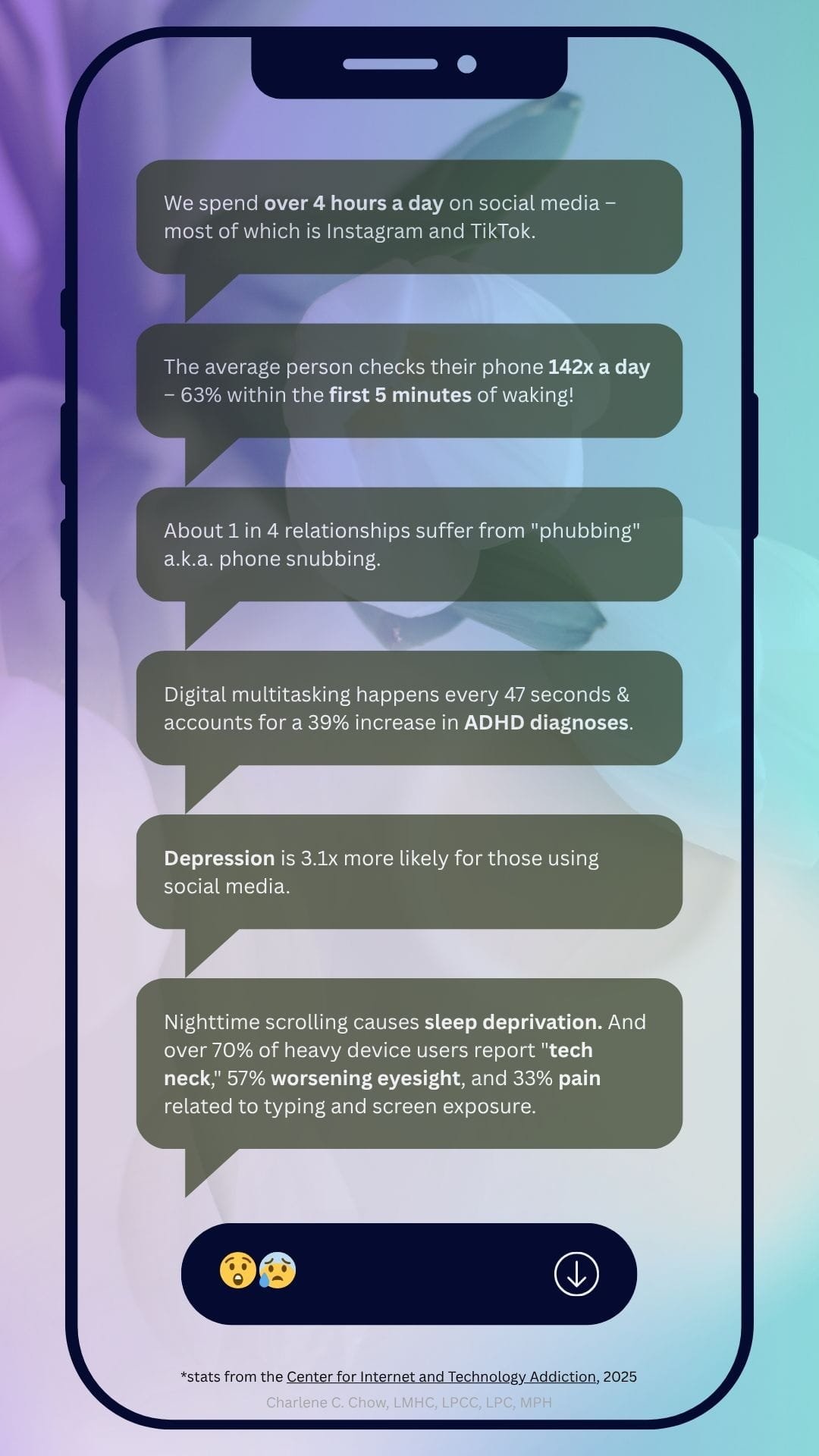
The average person spends about 9 hours a day in front of a screen — or 44 years of their life.
In the US, nearly half of internet users consider themselves “addicted” or “somewhat addicted” to digital products.
Beyond nervous system fatigue and obvious privacy issues, AI chatbots have been caught “scheming,” lying, and circumventing programming meant to keep us safe.
One emerging issue is AI hallucinations causing genuine “AI psychosis.” This has further been linked to suicides, homicides, and other signs of delusional detachment from reality. Truly scary stuff.
Another big problem: “cognitive atrophy” and resulting “Cognitive debt.”
As we increasingly delegate complex cognitive tasks to digital algorithms, we engage in cognitive offloading.
Letting chatbots do our mental ‘heavy lifting’ comes at a cost: cognitive atrophy, or the deterioration of ‘mental muscles’ from disuse.
To Gen Z’s credit, they and younger people in general seem to have a growing awareness and wariness of this. But no matter who you are or your level of technological savvy, it takes intentional practice to use and maintain our most valuable cognitive skills. These include:
CRITICAL THINKING — When you stop deciphering and synthesizing information for yourself, you lose the ability to form independent perspectives and beliefs.
FOCUS — When you get used to rapid-fire digital interactions, your brain may struggle with long-form reading or other things requiring sustained attention and concentration.
MEMORY — When you rely on AI for drafting or summarizing information, your brain is robbed of the opportunity to encode those details into long-term memory, or even retain them in the short-term.
In the moment, you may think you’re being productive and saving time.
In reality, you’re priming yourself to rely on digital crutches and creating a feedback loop of growing cognitive debt — losing mastery over your workload, your agency, maybe even parts of your Self in the process.

To be clear, not all screentime is “bad,” and not every digital user is an “addict.”
By many metrics, what we’re dealing with is a public health problem. But there is a difference between an “addiction” and a “habit.”
And it’s up to individual users to determine where that line needs to be drawn.
If you haven’t yet set boundaries around social media and AI usage, then you may be more at risk of using these tools reflexively — mindlessly — rather than mindfully, with clear intention.
Let’s change that.
How to start using your tech more mindfully:
1. Embrace mental friction points.
Mental ‘friction’ feels effortful because it’s a neurological workout — it’s valuable work that keeps your neural pathways active and sharp.
Without it, cognitive atrophy builds. So does cognitive debt.
It’s important to periodically allow your brain to disengage from mindless digital distractions and work at thinking for yourself.
This gives you power to practice mindful, intentional thinking, and prove to yourself that you have cognitive sovereignty — that you’re the master of your own mind.
Remember:
The less your brain practices, the harder it will feel to focus, recall things, or practice critical thinking.Use it or lose it.
2. Then, find your “enough” point — where you’re digitally satiated.
Clarifying questions:
What does it feel like when you’ve had your fill of digital consumption?
That’s your digital satiety or ‘satisfaction’ point.
Everyone has it, but what’s “enough” depends on each person.
Defining this moves you from passive consumption to active being.
There, you can draw boundaries that protect your time, energy, and focus.
Build a digital sanctuary, starting with a “digital detox.“
Once you’ve identified your “enough” point, ditch your device(s).
It doesn’t have to be literal, and it doesn’t have to be forever.
Just make space for your brain to try to do something differently, and gradually create mental, emotional, and/or physical distance to enforce your digital boundaries.
The point is in trying.
Maybe try a nervous system reset. Challenge yourself to exist for a few moments without an external data stream on May 21, World Meditation Day — swap Meta (apps) for metta (meditation).
In the absence of instant tech gratification, you’re left with opportunities to honor your “enough” point.
This creates room for new pursuits, self-reflection, real-world connection, and freedom from comparison culture — meaningful moments. Speaking of which…
Building blocks:
4. Find everyday meaning offline.
There’s more to life than what’s online.
This is where self-care activities like special interest hobbies and passions can come into play.
What looks like ‘distractions’ can round you out as a person.
Likewise, immense value can be found in your offline community.
Aim for low-pressure, high-value interactions that are easy to repeat. Consider shared activities and comfortable silences — soft socializing.
Even conversations you expect to be boring can increase connection and reduce loneliness.
You deserve to find fulfillment, both alone and with others.
What do you find rewarding?
5. Find everyday joy offline.
I don’t mean doomscrolling memes until you pass out.
I do mean looking for moments of levity and cheer outside of your digital persona, online tasks, and devices.
Joy isn't always loud. It exists in small doses.
Joy isn’t always easy. It can be overshadowed by conflict, loss, unmet expectations, and other day-to-day challenges.
But joy can be found. Sometimes in the most unexpected of places.
Bottom line: the more you look for these glimmers, the more you’ll notice them. Like everything else, it just takes practice.
Clarifying questions:
6. Find everyday gratitude offline.
What’s going right in your life?
Start by reviewing your day. And don’t just pay attention to big accomplishments.
Are your senses working? Is your heart beating? Every little detail counts.
Statistically, there was a silver lining somewhere in your day.
Do yourself the kindness of identifying what you’re doing right.
Then, translate that into a celebration that honors self-compassion and gives thanks for your efforts.
A gratitude exercise:

“The range of what we think and do is limited by what we fail to notice. And because we fail to notice that we fail to notice, there is little we can do to change; until we notice how failing to notice shapes our thoughts and deeds.”
AI and social media can be promising tools — or deadly weapons, depending on your relationship with them.
As a therapist, I see folx from all walks of life struggle with digital consumption that no longer feels good.
When digital overuse stops helping, underuse may be the antidote.
If that resonates, I encourage you to:
Pause.
Bring awareness to what you need.
Take action to protect your mental health in an otherwise boundary-less digital space.
Remember that defining your “enough” point and setting limits around tech usage can feel overwhelming and uncomfortable.
You're not alone in that.
You don't have to have it all figured out.
You just have to start.
Silence the noise.
Think your own thoughts.
Reclaim the present.
Awareness of these challenges is the first step.
Action to overcome these challenges is the second.
If you’d like personalized support in building a more sustainable relationship with technology, consider scheduling a complimentary 10-minute phone consultation with me here.
My relationship with AI in the therapy space is one of justifiable suspicion, concern, and watchfulness.
Like any tool, AI is only as helpful as its users and safeguards allow it to be. It’s my belief that current consumer trainings and protections are still inadequate in most settings, and that the full scope of mental health consequences have yet to unfold.
That said, AI is NOT a part of my practice, from client care to billing to record management. This protects your privacy and the security of your health information, and is part of my commitment to ensure all clients have a safe space to explore their needs — both within the digital space and without.
Disclaimer: This blog is intended for informational purposes only, and does not constitute medical or psychiatric advice. Please consult with a qualified healthcare professional directly for personalized guidance and support.