
Soft-Start Your New Year Using CBT Concepts & Tools

We’re two weeks into 2026. Have you recovered from the end-of-year festivities yet? Are you ready and rarin’ to go?
Or did you hit the ground running only to feel like you’re already behind?
Between getting back into old routines and keeping on top of new resolutions, January can feel harried, chaotic, out of control.
If you haven’t yet had a chance to slow down and take a breath, consider an alternative that lets you ease into the year with intention more than intensity.
Let’s call it a “soft start.”
What does a soft start to the year look like?
Rather than fighting the fact that January is cold, dark, and draining, a soft start encourages you to use this lower-energy period to rest, reflect, and recover.
It looks like a gentle stabilizing of disrupted routines, and an acknowledgment that the end of a year can cause emotional whiplash and very real burnout.
That’s a lot for your nervous system to both adjust to and bounce back from.
And yet… consciously choosing a slower-seeming pace can trigger problematic internal narratives and self-talk, such as calling yourself “lazy” or “unproductive.” When this happens, your brain may weaponize “new year, new me” logic, drawing focus away from the compassion and restoration that you deserve after an intense period of hustle and bustle.

How do you implement a soft start?
This is where cognitive behavioral therapy (CBT) can help.
In CBT, we focus on cognitive distortions, which are biased ways of thinking that aren’t necessarily grounded in facts, but which feel true in the moment.
High-pressure, high-stress periods in particular — like the transition to a new year — can lend themselves to distorted thinking because the expectations we set for ourselves are often arbitrary, vague, or artificially inflated.
The good news is these thought errors provide a clear target for change. And correcting these distortions is a step towards inner peace.
Ask yourself this:
Where are your thoughts inaccurate?
Are you seeing the big picture, or are you unintentionally cherry-picking the way you see the world?
How can CBT help untangle distorted thoughts?
Knowing where your thoughts are skewed is the key to preventing unnecessary emotional turmoil and gaining clarity around your life experiences.
In CBT, we accomplish this via cognitive reframing & restructuring.
Let’s start with some of the most common cognitive distortions I see in my practice this time of year, along with alternative ways you may choose to think instead.
These are all-or-nothing, either-or, absolute kinds of statements that sound pretty straightforward, but in reality ignore the complexities of the human experience — the ‘gray area’ between the black and the white.
Example: "I missed my morning walk today, so my goal of being healthier this year is already a failure. I might as well give up."
How to reframe: look for the gray area, because progress exists on a continuum, and even small wins count.
What to say instead: "Today might be over, but tomorrow is a new day and another chance to succeed."
Hypotheticals
This is “shoulda, woulda, coulda” thinking. “Should statements” are based on rigid expectations and unrealistic demands that set you up to feel guilty or call yourself a failure when you inevitably cannot meet them.
Example: “I should feel more motivated because it's a new year."
How to reframe: center what IS your need or preference, rather than what should/would/could have been.
What to say instead: "The end of 2025 really took its toll. I understandably feel run down, and it's okay to rest."
This is you pitting yourself against others; in reality, you know only what you perceive about others. This gives you a partial truth at best. No two people share the same exact lived experience, therefore no comparison can truly be accurate.
Example: “I’m just not as smart as my coworker."
How to reframe: center who YOU are, not who anyone else is.
What to say instead: "I received different training and bring other strengths to the table."
Filtering
This is focusing exclusively on the negative and ignoring any positives. These statements skew your worldview, just like looking through a telescope at one piece of litter in the sand will distort your view of a beautiful beachscape.
Example: "I managed to cook healthily all week but had cake for dessert. I lack willpower to be a healthy person."
How to reframe: practice UNfiltering by finding a balanced or even dialectical perspective.
What to say instead: "Dessert does not negate the value of my nutritious meals. I am able to eat healthily without restrictively dieting; both these things can be true."
Labeling
This is essentially name-calling yourself. Instead of acknowledging a specific mistake, you apply a generalized, negative label to your Self that turns a temporary action into a permanent identity.
Example: "I didn't finish my to-do list today; I’m lazy and incompetent."
How to reframe: describe the problem rather than embody it.
What to say instead: "I didn't finish my to-do list because I had low energy today."
Jumping to Conclusions
This is mind-reading or fortune-telling, as if what you think is already foretold. More often than not, this is actually a projection of our own fears and insecurities without verifiable, real-life proof.
Example: "People think I’m incompetent and lazy because I haven’t crossed more off my to-do list."
How to reframe: examine only the evidence that you've observed firsthand.
What to say instead: "Everyone is caught up in their own to-do lists. We're all trying to get through a lot."
Minimizing & Maximizing
This is discounting things that are actually more important, and overweighing things that aren’t important. They lead to emotional invalidation, and aren’t mutually exclusive.
Example: "I misheard my partner divvying up chores yesterday, and a breakup is coming. They’re justified in calling me names."
How to reframe: re-examine events as if you were hearing about them from a loved one.
What to say instead: "Misunderstandings are normal. They don't automatically lead to breakups, nor do they warrant unkind insults."
Emotional Reasoning
This is the belief that your feelings are objective truth. In reality, feelings come and go; they can be grounded in the “now,” or influenced by past experiences that may not be relevant today. They are not inherently logical, by definition.
Example: "I feel overwhelmed and behind, therefore I am behind and my life is a mess."
How to reframe: remind yourself feelings are not facts, only a piece of the puzzle.
What to say instead: "I can feel overwhelmed while actually being exactly where I need to be. That can be true without defining me or predicting my life course."
Need a little more structure?
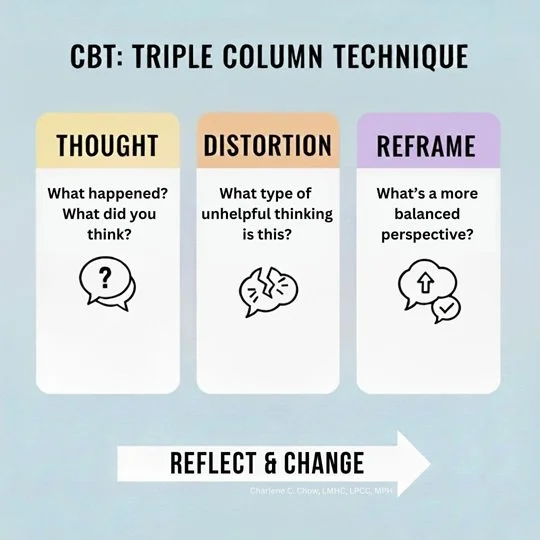
If you’re still struggling to sort through these distortions, here’s one more CBT tool to consider: the Triple Column Technique.
When done right, this can help you identify, label, and challenge your own negative thoughts by charting them across 3 columns.
There are a few variations on this, but here’s the column structure I recommend starting with:
Thought: write down the “problem thought” that’s causing you distress.
Distortion: name which cognitive distortion is at play.
Reframe: find a more accurate — and likely more compassionate — truth, with which to replace your problem thought.
Ask yourself this:
How does this thought structuring exercise feel?
What and where are your mental sticking points?
Looking ahead at the big picture…
What works for you today may not be what works for you in a week, a month, a year — and that’s okay. . . . . . . . . . . . . .
What works for you today may not be what works for you in a week, a month, a year — and that’s okay. . . . . . . . . . . . . .
“If a man does not keep pace with his companions, perhaps it is because he hears a different drummer. Let him step to the music which he hears, however measured or far away.”
January is just a month, and New Year’s Day is just the first date on the calendar.
Remember that your value is not measured by just your productivity in the first month of any given year. You are so much more than that.
Likewise, mental wellness isn’t a singular event constrained by the calendar. It’s a marathon.
Mental wellbeing comes from practicing returning to yourself with kindness and understanding.
Consistently.
Repeatedly.
Over and over again.
You have your entire life to grow, change, and learn — make it work for you.

Are you finding it difficult to quiet the external noise and keep pace with your own needs?
Do you have a sense of what pacing works best for you?
Many of my clients face these questions year-round, not just at the start of the new year.
Working through cognitive distortions is challenging. It is not a “natural skill” for most folks. But it is a skill that can be learned. And you don't have to do it alone.
If you’d like more structured support in tuning into your intrinsic values and needs, consider scheduling a complimentary 10-minute phone consultation with me here.
It would be my honor to hold safe space and work with you to overcome any barriers preventing you from moving forward with the clarity and inner peace you deserve.
Disclaimer: This blog is intended for informational purposes only, and does not constitute medical or psychiatric advice. Please consult with a qualified healthcare professional directly for personalized guidance and support.