
Look Back to Move Forward: A Year-End Mental Health Review
As 2025 winds down, many of us are now reflecting on our professional paths, our budgets, our personal goals. If you’re anything like my clients, you’re also juggling checklists, end-of-year obligations, possibly travel. Maybe since before Thanksgiving.
We scrutinize every little external event to gauge whether our year was “good” or “bad.” Yet when it comes to mental health and wellbeing, our review process is often less thorough, more self-critical.
Do you fall into the trap of judging yourself harshly when you reflect on the past?
If so, I encourage you to consider trying something different this year: a year-end mental health review.
What is a mental health review?
This thought exercise is a judgment-free way to take inventory with compassion.
What ISN'T a mental health review?
- A rigid audit.
- An objective assessment.
- A scored evaluation.
- A basis for self-judgment, criticism, or self-blame.
Please don’t confuse this with a “performance review” like you might get from your manager at work.
There’s no grading, no “success” or “failure” here, only a mindful look back at what shaped your emotional landscape over the last year.
This lookback is subjective and personal, and includes among other things:
The challenges you faced.
The thinking patterns you carried.
The questions you navigated.
The decisions you made.
The resources you gathered.
The skills you learned.
Thought questions:
Were there times you mindlessly did what you thought you “should” do — or did you fully understand and manifest your agency in a way that always fulfilled your emotional needs?
How did that work out?
What’s the benefit of doing a review?
The goal of this self-reflection is not to find flaws, but to build insight.
In seeing what happened, we give ourselves the opportunity to consider how much of our doing was mindless as opposed to intentional.
Moving forward mindfully instead brings clarity and awareness that you can take (maybe different) actions that will better meet your needs next year.
How do you conduct a year-end mental health review?
There isn’t one right way to do this.
In my practice, I draw from several therapeutic models, because coping with modern life demands a variety of skills for both challenging distorted thoughts and processing uncomfortable emotions.
I recommend starting with a lookback at just two overarching themes: your challenges and your celebrations.
1. What were the challenges?
When you reflect on tough moments in 2025, it seems easy to blame circumstances and say “I failed.”
But sometimes the source of our distress isn’t our external situation or an event itself, but our internal interpretation of it.
Our brains are constantly filtering reality to find patterns. Unfortunately, this process isn’t perfect. And most of us haven’t been trained to do it effectively outside of therapy.
When your brain’s filter is biased, you end up with inaccurate conclusions. Your thoughts then become a roadblock, making challenges seem insurmountable.
Pinpointing these inaccuracies is the first step toward loosening their grip.
This is where evidence-based cognitive therapy (CT) modalities can be useful. I lean heavily on these in my practice because they share a core principle: the way we think influences how we feel and behave.
In a mental health review, you can use these frameworks to contextualize your emotional lows:
Cognitive behavioral therapy (CBT): Learn to identify and restructure thought distortions that made challenging situations feel even worse than they were.
If you primarily think in all-or-nothing terms, minimize your ‘successes,’ and maximize your ‘failures,’ CBT can help flip that script.Rational emotive behavior therapy (REBT): Learn to challenge irrational core beliefs that may be underlying and fueling your thought distortions.
If you tend to get stuck setting fairly arbitrary or absolute standards for yourself, REBT can help untangle appropriate expectations from self-defeating narratives.
A mental exercise:
THINK ABOUT: Arguments. Sleepless nights. Times you lacked motivation or purpose.
ASK YOURSELF: Did your thinking add to your distress? Where and how so?
2. What were the celebrations?
To do a complete mental health review, you can’t just focus on the challenges — you must also catalog your wins.
Where did you experience this? Big or small, are you able to recognize moments that warrant celebration?
These prove your coping strategies and inner resources are working. Carrying this forward intentionally further fuels healthy emotional regulation and resilience.
To diversify your coping toolkit, you might start to look at other therapeutic paradigms at this point. In my practice, for example, I also rely on modalities that emphasize emotion and acceptance, such as:
Dialectical behavior therapy (DBT): Learn to identify and acknowledge moments where you successfully managed difficult interactions and feelings.
If it’s difficult for you to self-regulate and self-soothe when emotions run high, DBT can help you learn distress tolerance and interpersonal effectiveness skills.Acceptance and commitment therapy (ACT): Learn to have psychological flexibility in order to find things worth celebrating, even within the most challenging situations.
If you find it difficult to accept and defuse certain thoughts or feelings, ACT can help you move through that and take actions that align with your core values — and that alone is something to celebrate!
A mental exercise:
THINK ABOUT: Feeling relief after boundary-setting. Gaining clarity from journaling. Experiencing less distress with the help of healthy routines.
ASK YOURSELF: Where did this happen over the last year, and how can you cultivate this more next year?
Your year-end mental health review is a "success" when you can summarize your journey over the last year without judgment, self-criticism, or self-blame.
----------------------------------------------------------------------------------------------------------------------------------------------------------
Your year-end mental health review is a "success" when you can summarize your journey over the last year without judgment, self-criticism, or self-blame. ----------------------------------------------------------------------------------------------------------------------------------------------------------
OK, you’ve finished your year-end mental health review… now what should you do?
One last thought question:
Is reflection enough, or is your insight compelling you to act?
(There is no universally “right” answer to this question — only what’s right for your needs in each moment!)
Actually, that’s a trick question.
It’s not about “should” — it’s about “will.” What will you do with this information?
Maybe the answer is “nothing.” If this year went smoothly, and you’re content where you are now, that’s great! Keep it up!
But maybe that wasn’t the case. If so, it’s even more critical to view your successful coping as a result of the healthy skills you learned.
Once you’ve finished your review, the only thing you NEED to do is stop treating your wins as accidental — start seeing them as reproducible actions that you have control over. That’s it.
Anything else would be a bonus, and is completely your call to make.
What if you are ready to take action and make some changes?
Again, completing a mental health review doesn’t obligate you to do anything differently.
Your biggest asset is awareness of both your most common cognitive roadblocks AND your best go-to strategies for coping.
However, if and when you ARE ready to make some changes, these experiential data points can be used to craft a strategy that honors your needs and helps you thrive in the year ahead.
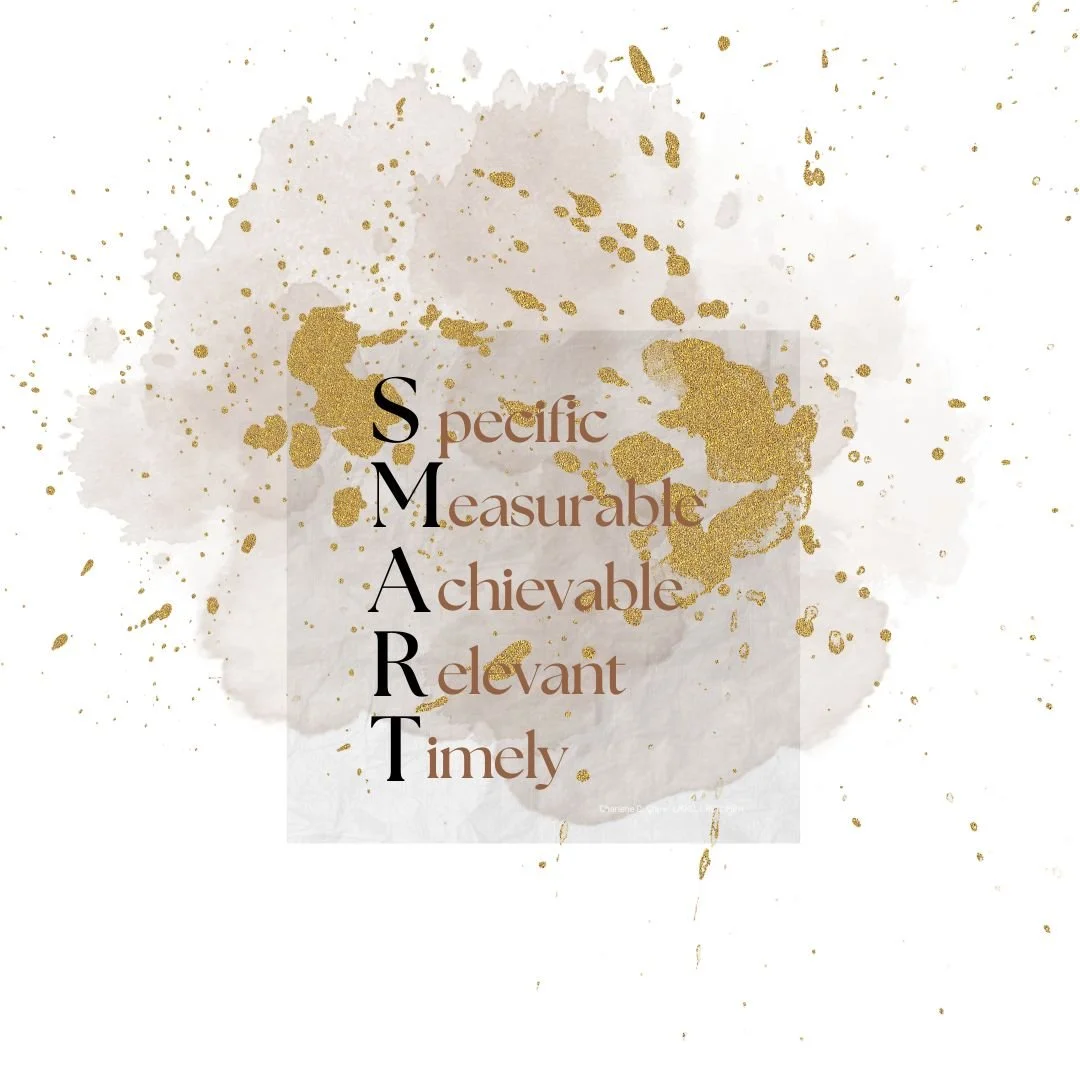
So if you ARE ready to translate your awareness into practical actions in the new year, I suggest starting with SMART goals.
We’ve all set goals that sound good on paper, but are overly simplistic, broad, and vague, like “I’ll be happier next year.” This is what many people end up doing by accident with new year’s resolutions — and also why many end up “falling off the wagon” not long into the new year.
Vague goals are aspirational. They’re fine as positive affirmations for general intention-setting, but they don’t equate tangible actions.
Fine-tuning your goals to make them SMART instead will help convert the insights from your review into a clear, concrete path forward.
Doing so ensures your goals will be sustainable, compassionate, and tailored to the exact needs and challenges you uncovered in your mental health review.
Example:
If you’re still looking for one final takeaway, it’s this:
even with all the uncertainty in this season and in the world today, you have the power to give yourself peace of mind, clarity, closure, and positive change in the year ahead.
Conducting a year-end mental health review is the first piece of that puzzle.
My clients find these especially helpful this time of year, and I sincerely hope you will too.
Happy holidays.
Are you struggling to conduct your mental health review or identify SMART goals?
Many of my clients face these same issues year-round, not just during the holidays.
Breaking these patterns may not come naturally, but you don't have to do it by yourself.
If you’d like more structured support in conducting a personalized mental health review, consider scheduling a complimentary 10-minute phone consultation with me here.
It would be my honor to hold safe space and work with you to overcome any barriers preventing you from moving forward with the focus and self-determination you deserve.
Disclaimer: This blog is intended for informational purposes only, and does not constitute medical or psychiatric advice. Please consult with a qualified healthcare professional directly for personalized guidance and support.